The BLOG section is a space for sharing a wide range of content—from philosophical and aesthetic reflections, reviews, and work-in-progress notes to practical resources such as instructional videos, code, and literature.
Campo de batalla: la música de Davor Vincze Review by Ismael G. Cabral of Ashes (Kairos CD) for El Compositor Habla (English translation)
© 2026 Ismael G. Cabral
Davor Vincze (1983) defines himself as a composer and sound artist, yet this monograph now issued and distributed by the Kairos label gives us the measure — or, at least, a broad portrait of the musician across eleven years of activity — his work as a composer aligned with multiple contemporary (all of this assuming we accept the subtle and unstable distinction between composition — as we roughly understand it in the context of modernity — and sound art as a more heterodox expression difficult to confine to acoustic devices those gathered here).
The album opens with a maximal gesture, Ashes (2024), performed by the New York ensemble Alarm Will Sound, is one of the most outstanding works on the disc. Inspired by the contemplation — and, we should add, the sonic — of a Taoist procession during Chinese New Year celebrations in Hong Kong, Vincze connected that experience elements culturally and sociologically closer to him, such as the wars in Yugoslavia. That sort of frenzy, that religious and festive tumult, then found an in his creative mood. Thus, very loosely, listening to Ashes can link us (vaguely substantially) with other hearings of contemporary scores rooted in similar displays of popular culture: Gougalon by Unsuk Chin and Kantrimiusik by Mauricioel, in particular. However, in Vincze theiscence does not remain merely formal or celebratory. Ashes is a work made of multiple layers in which an almost electroacoustic thinking peeks through (the idea of composition by strata of authors, example, as in Francis Dhomont and Eduardo Polonio): the density the ensemble attains is of timbral complexity. Its ambivalence is also striking; the instrumental texture is as jubilant as it is warlike. This is aided by some extremes in the orchestration, such as Erin Lesser’s piccolo and Elisabeth Stimpert’s bass clarinet. It is, therefore, a confrontational piece in which as listeners, we do not know (nor is it necessary to know) how the present and the past in the composer’s memory. Although it is evident — as in the disc’s copious notes — that this is fundamental. The title connects to a song that is a real-life experience of the author, David Bowie’s “Ashes to Ashes,” who a concert at Zagreb’s Maksimir Stadium in1990. One year later — distilling a gigantic conflict to its skeleton — that city would be at war. From what has been outlined so far one might infer that Ashes, as a composition, tends towardanglement, toward unresolved violence However, in a very particular way Vincze endows the score with a sense of beginning and fuga (perhaps like the procession he witnessed): the music keeps moving forward, acquiring different contours; he guides it toward an ending in which material left so exposed that it is exhausted, as if it could give no more. Following a very subjective order of interest, we prize highly Na Crti Crta (2017), for a concise ensemble of marimba, percussion and tape, performed by the Hague ensemble HIIIT. Again we encounter a sombre discursivity charged with an energy that makes it highly suggestive to the ear It is that energy and its gradual loss of force that Vincze explores in a creation stripped of pretension and articulated as a study sonic qualities with a refinement that renders it of great interest. The score also mirrors Bachian resources, extracting phrases that become unrecognizable but that, if one is unaware of the source, color this music with an unexpectedly welcoming tone. It is, in any, another historical sprouting in Vinc’s oeuvre; one nourished as much by other musics (and genres) in his catalogue as by lived experiences and exposures. In these miniatures the achieved sophistication is maximal, as is the tightly woven timbral fabric; the materials converse without a classical line of development, yet they appeal to emotions in a constant way. Continuing the survey, let us now cover the most demanding piece of all, the string quartet Oltre il conflitto (Or Why I Left Croatia) (2017), here performed with an Arditti‑like dryness by the JACK Quartet. The film The Wolf of Wall Street (2013) by Martin Scorsese and the work of Italian photojournalist Marco Longari, depicting cities besieged by war and famine, are the creative stimuli that inevitably culminate in a fierce work that is enriched (despite the composer’s biography) by the anxiety Vincze suffered from having grown up and developed in a geographic environment where aggression and conflict seemed ready to erupt at every turn of the calendar. Rather than speaking of violence — in the concrete reference to the quartet’s music — we should refer to its profusely somber character. It’s not that there isn’t virulence among the four stands — and in abundance — but it has muted, agonizing contours; we would not speak of the expansive brutality of Xenakis’s Quartets here; the horror seems already processed, lived and internalized. Persistence of trauma. All this seems anticipated by the title itself, which speaks more of the echo and terror that endure beyond a specific, looming danger. It speaks of what comes after. This is also how JACK understands the piece, in which the concern is less with climactic peaks than with a sense of continuity. The tension remains from beginning to end; we do not know where it comes from, nor is it resolved, as if it continued far beyond the final double bar. This makes it substantial and hard to assimilate; in its hyper‑expressionist stubbornness the strings are juxtaposed and charged through very physical pressures, horrific glissandi and the recurrent use of mutes that blur the classical sonority and seek to deepen a terrifying atmosphere that (physically) no one would wish to experience.Preceding that last work is another in which the string is central: #MeMyselfAI (2021) for violin and live electronics. Performed by Roberto Alonso Trillo, this is the most destabilizing immersion on the monograph, since it features an electronic apparatus that is better understood in the concert setting than in its capture on the album. Even without any other reference than the present recording, Vincze operates here in a manner opposite to how he constructs Ashes; instead of adding layers, #MeMyselfAI advances by a gradual stripping away of the elements at play. Among those elements is a digital voice, albeit with a human character, which adds an extra ingredient of disorientation. We cannot tell what is meant to dissolve into what—whether the violin into the digital, or the digital into the acoustic. The soloist is able, despite the textural assault of the digital environment, to keep his musical discourse afloat. That back-and-forth of forces, in short, remains effective throughout the piece, even as the idea that the digital absorbs and incorporates the strings’ plasticity becomes increasingly noticeable. Reducing the whole thing to a hyperbolic parasitism of technology over the human would be such a spartan exercise that we do not believe Vincze’s intentions are limited to that.
Inflection Point (2011), for ensemble, facilitates a reunion with the great conductor Reinbert de Leeuw, here leading a ten‑strong group from Ensemble Modern. The ensemble’s pianist, Ueli Wiget, plays the celesta, which becomes a substantial timbral element that grounds and filters much of the fragile sonic flow of a score that shows a side of Vincze’s compositional outlook that is aesthetically earlier than what has been discussed so far. Nevertheless there is a very old connection with Ashes: its sense of an almost magmatic organic mass. The ensemble moves in an extraordinarily restrained way, and from the fluid emerge colors and timbres that flicker briefly and give way to others, as if the work sought a chromatic saturation that left no option but fracturing. We also glimpse ghostly frequencies that point to the electronic, which are eventually realized with the entry of a tape that overwhelms and devours the ensemble in the opening bars, then subsides and embeds itself in the progression of a tremulous, deliberately diffuse musical substance.
The Zafraan Ensemble closes the album with acousti©remations (2022), in which war is invoked again (out of personal necessity and also humanist conviction) — as an event of the recent past and the atrocious present — illustrated once more with all the violence and unease it brings. If the previous works were conceived through the compacting of materials (with the exception of the more aphoristic Na Crti Crta), here Vincze returns to the stave with a focus on the density of timbral and textural accumulations, while at the same time producing unexpected shifts in rhythm and dynamics, and suspensive silences that abort the sense of continuity that — at least in these pages — characterizes the music of the Croatian composer. With a keen intuition for the drama produced by ruptures and the collision of low/high extremes, the piece finds in Zafraan’s performers suitable accomplices to disentangle the complexity written into the scores and render it with the necessary impact. The music does not eschew a decibel pyrotechnics that creates a mood, a state of attention that other works mask or encrypt. Taking the martial as its basis, the scene becomes a context of conflict. The work does not hide: it aims at an abstract programmatism in evoking — among other horrors — the Jasenovac concentration camp, where thousands of political prisoners were tortured and executed. Delving further into the signifiers of the pieces collected here, one finds another train of thought of horrifying plasticity; perhaps all the ignition exuded by the combination of Vincze’s instrumental materials (which in acousti©remations are emancipated into a state of ruthless intricacy, superbly rendered by the members of Zafraan) relates to a feeling of a crematory pyre, of calcination and ashes, of burning (as memorial and also metaphorically) of unbearable realities.
Review by Ismael G. Cabral

Album Ashes by Davor Vincze: between Bowie, Bach, Berg and Laibach — an intense/poignant musical journey from chaos to hope.
© 2026 C. Cornell Evers
Ashes steers between extremes: destruction and hope, memory and imagination, human and machine. Reference points include David Bowie, Johann Sebastian Bach, Alban Berg and Laibach. The music hits immediately and hard with the title track, which explodes like a Big Bang, performed by the vital American chamber orchestra Alarm Will Sound—a name that feels particularly apt here. Born in Croatia in 1984, composer and sound artist Davor Vincze works around themes such as chaos, destruction, hope and the distinction between human and machine. Those themes are closely tied to his youth in war‑scarred Zagreb. Experiences of loss and insecurity left a lasting mark and resonate in his music. At the same time he situates that personal background in a broader context where technology, philosophy and imagination converge. In his compositions Vincze combines traditional instruments with electronics and new technologies. He uses algorithms and machine learning (a form of artificial intelligence in which systems learn from data) to deform existing sounds and develop new musical structures. He thereby explores not only the possibilities technology offers but also the imperfections of both human and machine. The six compositions on Ashes form a cohesive whole. The album sketches a world that is at once personal, historical and cinematic. More than a collection of pieces, it is a continuous train of thought, a story unfolding in sound. The title is telling: ash not only stands for loss, but also for what remains after burning and can form the basis for new life.
The album booklet, featuring the highly readable essay ASHES—Music Between Chaos and Reflection by Laura Emmery (Assistant Professor of Music Theory at Emory University), sheds additional light on that layering. It shows how strongly Vincze’s wartime youth in the former Yugoslavia reverberates in the music. Yet it does not remain a merely personal look back: his experiences are connected to broader themes like violence, uncertainty and collective trauma, giving the album a more universal resonance.
The inspiration for the title work underlines this. Ashes (2024) for chamber orchestra was partly prompted by a visit to a Taoist temple in Hong Kong, where “smoke, ritual and silence flow together with memories of war and loss,” and by Vincze’s childhood. The piece lets chaos and stillness coexist, with subtle references to David Bowie’s “Ashes to Ashes.” At the same time it is dedicated to the innocent victims of the wars in the former Yugoslavia.
In #MeMyselfAI (2021), Vincze, together with violinist Roberto Alonso Trillo and ensemble Vertixe Sonora, explores the tension between human and artificial intelligence via machine learning and the idea of “hidden” representations: abstract, compressed descriptions of complex data in which similar elements are close together. He proposes that musical works can also exist in such a multidimensional space, where fragments are stored as discrete points (with attributes like timbre, rhythm and harmony) and are creatively reconnected into new material.
This composition, based on Alban Berg’s Violin Concerto (1935), recombines existing musical fragments using his microllage method (a blend of micro and collage). He selects, reshuffles and redefines relationships between musical elements on multiple levels. Berg’s Violin Concerto, “To the Memory of an Angel,” concerns the death and glorification of Manon Gropius, the early‑deceased daughter of Alma Mahler and Walter Gropius, who died on 22 April 1935 at age 18; Berg composed it as a musical requiem and incorporated, among other things, the Bach chorale Es ist genug. The interplay between violin and electronics blurs the boundary between human and machine and raises the question of what remains human and what is artificial. Where Berg’s work reflects mourning and the end of an era, #MeMyselfAI sounds like an almost desperate response to “the loss of biodiversity and humanism in the wake of the COVID‑19 pandemic, and the resulting isolation and digitization” (Laura Emmery).
The next piece moves along irregular paths, at times chasing, at times wandering. Oltre il conflitto (or Why I Left Croatia, 2017) for string quartet—performed by the JACK Quartet—is inspired by the composer’s war experiences and by a retrospective exhibition he visited of Italian photojournalist Marco Longari on conflict zones. The music breathes constant unrest and uncertainty, making palpable the ongoing tension and fragility of peace. Inflection Point (2011) for mixed ensemble takes the mathematical idea of an inflection point (as in a graph) as a metaphor for change and renewal. The piece suggests a shift from order to chaos, with electronics playing an increasingly important role. At the same time the threat of collapse, carried out amid loud tumult, remains constantly present in the background. Although Inflection Point is now fifteen years old, it has lost none of its urgency. The 2012 recording at the Haus der Deutschen Ensemble Akademie in Frankfurt, performed by Ensemble Modern under the late Reinbert de Leeuw, flows—as almost all the compositions on Ashes do—seamlessly into Na Crti Crta (2017) for marimba, percussion and tape by members of the Dutch ensemble HIIIT.
Na Crti Crta was created in 2014 as a commissioned work for an international festival and was later revised. The title seems to refer to lines or boundaries and evokes associations with conflict, although Vincze explicitly leaves room for a personal interpretation. The piece combines sharp sound masses and rhythmic tension with more subdued passages in which resilience can be heard, and it culminates in a powerful release. The work consists of five short movements centered on decay and mortality. Vincze alludes both to the Slovenian band Laibach and to J. S. Bach. Electronics and algorithms are used to process and deform existing musical material. Laibach — also the historical German name for the Slovenian capital Ljubljana — is known for recontextualizing music, a practice that inspired Vincze. At the same time he reads the name as a word play on “Lai” (layperson) and “Bach”: “Lai‑Bach.” Using algorithms “that have no historical or stylistic awareness,” he generates new material from Bach’s Sixth Brandenburg Concerto, which thereby “detaches from its context and appears as an artifact from a distant past” (Laura Emmery). In acousti©remations (2022) for mixed ensemble, here performed by the Zafraan Ensemble, Vincze focuses on the atrocities in the Jasenovac concentration camp during World War II. The piece, with its staccato‑like structure of raw, piercing sounds and often dark percussion, evokes an atmosphere of fear and oppression. Jasenovac was the largest concentration and extermination camp on the territory of present‑day Croatia, established in 1941 by the nationalist and antisemitic Ustaša organization, which was rooted in fascist ideology. In 1945 the guards largely destroyed the camp to erase traces. In the composition the sound material slowly dies away into what we might call gray noise, or ash, within a structure that refers to both tangible and imagined spaces.
Vincze’s music bears the marks of his youth in war‑scarred Zagreb. Themes such as loss and trauma are clearly present but are continually balanced by a countervoice of hope. In his work the human and the mechanical merge; expression arises precisely in the frayed edges and imperfections, producing a layered reality in which memory and imagination constantly reflect each other.
That listening stance calls to mind a passage from My Bright Abyss by the American poet Christian Wiman, in the Dutch translation by Willem Jan Otten. There he describes how every person carries a kind of hidden music — not always pleasant, but penetrating and hard truly to hear. That seems exactly what Davor Vincze aims for with Ashes: he invites the listener to pay attention to what is uncomfortable.
The six works on Ashes reveal a composer who makes existential questions audible. Contrasts do not appear as fractures but as fields of tension: between chaos and hope, past and future, the concrete and the imaginary. The album moves between what was and what might have been, between what remains and what fades. What lingers, in the end, is music that not only strikes in the moment but continues to resonate like an echo, slowly transforming and settling with the listener.
Review by C. Cornell Evers

Listening Perspectives #11: “Davor Vincze, or New Music with History and Conscience” Review by Paco Yañez of Ashes (Kairos CD) for El Compositor Habla (English translation)
© 2026 Paco Yañez
A dazzling album, fiercely contemporary and profoundly human: Davor Vincze’s first monographic release on Kairos confirms him as one of the most lucid and intense creators in contemporary new music, capable of transforming memory, technology, history, and ethical consciousness into a sonic experience of overwhelming force. Davor Vincze: Ashes; #MeMyselfAI; Oltre il conflitto (Or Why I Left Croatia); Inflection Point; Na Crti Crta; acousti©remations. Roberto Alonso Trillo, violin. HIIIT. JACK Quartet. Alarm Will Sound. Ensemble Modern. Vertixe Sonora. Zafraan Ensemble. Reinbert de Leeuw and Alan Pierson, conductors. Constantin Basica, Justus Beyer, Cory Brodack, Felix Dreher, Iván Ferrer-Orozco, Stephen Gardner, Tom Gelissen, Daniel Neumann, and Laura Picerno, sound engineers.
My first encounter with the music of Croatian composer Davor Vincze took place in Lugo on December 18, 2021, during the ninth edition of the MIHLSons-XXI Contemporary Music Cycle. That evening featured a concert by violinist Roberto Alonso Trillo of Vertixe Sonora, who, together with Iván Ferrer-Orozco on electronics, performed five works, among them #MeMyselfAI (2021), a piece by Davor Vincze that we heard there in its world premiere. The recording of that concert has been included in Vincze’s first monographic release on Kairos — an album that, like #MeMyselfAI itself, is filled with acoustic landscapes as heterogeneous as they are fascinating, marked throughout by radical modernity as well as the Agramite composer’s reflections on his own biography and artistic trajectory. This allows the extraordinarily rich palette of musical resources employed here to serve a narrative and a humanistic mode of thought that are as personal as they are compelling. At the premiere, five years ago, Davor Vincze said of #MeMyselfAI: “In my recent work, I have been deeply intrigued by the idea of latent spaces, a term borrowed from computer science and machine learning. They are defined as an embedding of a set of elements within a manifold in which the most similar elements are located closest to one another. My artistic hypothesis is that any musical work could be placed within such a multidimensional space, stored there as a multitude of points, and then creatively reconnected in various ways. That is precisely what I did with Alban Berg’s famous Violin Concerto in this piece. My artistic work consisted in searching for new pathways connecting fragments of existing music in order to generate a new composition. Through the compositional strategy I call ‘microllage’ (micro + collage), I generate new compositional constructions using certain aspects of Berg’s concerto on both macro and micro scales. Berg, in his work, paid tribute to the premature death of Manon, Alma Mahler’s daughter, while indirectly evoking the disappearance of Europe as he knew it. Starting from this idea, my composition speaks about the loss of biodiversity and humanism as a consequence of the current pandemic, and the resulting isolation and digitalization. From a strictly musical perspective, the interaction between violin and electronics attempts to blur the distinction between human performer and machine. Indirectly, I ask the following questions: Is the electronics artificial intelligence? Is the violinist artificial intelligence? Are both artificial intelligence?” Listening again to #MeMyselfAI almost five years later, now on compact disc, proved just as rewarding an experience as hearing its premiere. Although the spatialization and enveloping sound we experienced in Lugo are inevitably lost, Iván Ferrer-Orozco’s sound engineering remains astonishing in both power and transparency — two crucial qualities for this work. On the recording, we can no longer see the dramaturgy of concealment and shadows developed in the premiere staging, when Roberto Alonso initially performed behind a curtain. That staging functioned as a parallel correlate to Vincze’s own idea — already articulated in his text — of multidimensional concealment within Berg’s Dem Andenken eines Engels and its latent spaces. This dialectic of concealment and latency saturates the listening space with data in the form of musical materials that the audience must integrate: a network of acoustic information emerging both from Roberto Alonso’s febrile virtuosity and from the electroacoustic multiplication of his violin sound. Electronics, acting as a repository of memory and data, insert the music of the past into the acoustic-electronic continuum — Berg’s concerto, which, true to its title, allows the memory of Manon Gropius to drift like an angel in dialogue with the live violin, producing moments of violent and highly expressive collision between the two media. On disc, due to the intensely foregrounded sound mix, these moments become even more powerful. From all this it becomes evident — as already suggested at the beginning of this review — that the presence of electronics, computational media, or artificial intelligence in Davor Vincze’s music is by no means an exercise in mere fascination with technology itself. Rather, these media serve to summon the perpetual coming-and-going of ghosts emerging from our encounters with scores of the past and the people evoked within them. For this reason, Roberto Alonso’s own presence in #MeMyselfAI unfolds through varying degrees of exposure. In the hyperactive first movement, Singular Value Decomposition, Alonso physically hides from the audience, whereas in the second movement, Breaking Symmetry, he appears openly on stage. Vincze uses this transition to create an electronic interlude that expands the urban sonorities of the first movement through pulsating granular tension. After this electronic interlude, from the particles into which the violin had dissolved at the end of the first movement, the second movement gradually reorganizes, synthesizes, and multiplies the material, achieving an almost orchestral presence through a sumptuous acoustic-electronic polyphony. The listener feels as though the means deployed far exceed those of “merely” an amplified violin and electronics. Within the programmatic logic of the work, Breaking Symmetry gives the reorganized materials a greater sensitivity than the more mechanical first movement. The way Vincze works with spatialization creates the sensation that the violinist is literally absorbed by history into a musical superstructure that does not annihilate him as an individual, but rather blurs his limits and contours in order to expand them within that structure. The resulting sonic plasticity resembles a true sculpture of sound. Yet within this process of absorption lies something sinister and threatening: the realization that technology’s vampirization of the self can often erase rather than expand individual potential. This is precisely what #MeMyselfAIcompels us to reflect upon — although there can be no doubt that, in this case, technological means have been placed at the service of transcendent art. Yet if moments of sonic violence already appeared in #MeMyselfAI, they are redoubled in the abrasive opening of Ashes(2024), the work that opens the album and the most recent of the six compositions gathered here. We are confronted with a work written for a much larger instrumental apparatus: a large ensemble that evokes a long Taoist procession witnessed by Davor Vincze in Hong Kong during the celebrations of the Chinese New Year in February 2024. That procession — with its clouds of incense smoke and its peculiar form of organized chaos — became intertwined in Vincze’s memory with the Yugoslav Wars, which he himself experienced firsthand in his childhood. Those wartime experiences caused numerous traumas that even affected his musical vocation and studies, which — as Laura Emmery explains in her superb liner notes — shifted in Vincze’s case from music toward medicine. All of this generates different layers of sound, at times dense and overcrowded, at others stripped bare, in which we seem to hear everything from the timbres of Asian instruments in the percussion and woodwinds to sounds resembling a battlefield: bombs, sirens, distant alarms. A tumult of successive acoustic waves — such as the one emerging around the fourth minute of Ashes — integrates the materials carried along by this true twenty-first-century passacaglia, filled with cracklings that oscillate between the complete atomization of the ensemble, when individual elements seem to acquire lives of their own, and the cohesion of the work’s most massive and energetic passages. All this culminates in the final resonance of the cymbal, which leaves behind the halo of incense and the timbres of the procession like a fading trace in its wake: an abyss opening toward silence and memory, progressively dissipating like the smoke generated by the procession itself, leaving behind only a trail of ashes. In the case of Ashes, another musical reference joins those employed by Vincze in the score: David Bowie’s song Ashes to Ashes. Not only because the song suggested the title of the work, but also because it functions as a personal musical memory associated by Vincze with what he describes as the last great festive act of the former Yugoslavia: Bowie’s concert at Zagreb’s Maksimir Stadium on September 5, 1990, during the Sound+Vision Tour, shortly before Yugoslav unity collapsed in 1991 and Europe once again descended into bloodshed through a chain of wars. One of the artists who reflected most intensely on those Yugoslav Wars in his paintings, particularly in France and Spain, was Leopoldo Nóvoa, who frequently used ashes as a material in his canvases in order to extract, from the horror of what had occurred, a glimmer of hope through critical reflection on history. This is visible in late twentieth-century series such as Next Time the Fire. The same dialectic of critical reflection aimed at constructing new hope is also present in Vincze’s Ashes. In his case, however, the perspective is widened through the spirituality evoked by echoes of the Far East. These reflections take shape in a strongly directional music that itself compels us to continue moving forward — as does this extraordinary performance by Alarm Will Sound under the direction of Alan Pierson. Particularly striking in their interpretation is the powerful individuality of the ensemble’s instrumental timbres, as well as the cohesion Pierson gives to a work that could so easily fall apart given the enormous proliferation of details, rhythmic layers, and microforms converging within Ashes. If the memory of David Bowie surfaced in Ashes (2024), then in the string quartet Oltre il conflitto (Or Why I Left Croatia) (2017), the influences explicitly acknowledged by Davor Vincze are, on the one hand, Martin Scorsese’s film The Wolf of Wall Street (2013), and on the other, the retrospective exhibition Oltre il conflitto, which the Croatian composer visited and which focused on the work of Roman photojournalist Marco Longari. The exhibition portrayed the brutal everyday realities of inhabitants living in cities devastated by crisis, terrorism, war, or misery — places such as Nairobi, Jerusalem, or Palestine, as Laura Emmery notes in her liner essay. Once again, this brings Vincze back to his own youth in Croatia. We are thus faced with another work concerned with memory and, above all here, with the anxiety produced — both in the composer and in ourselves — by the awareness that the serpent’s egg of violence is incubating everywhere, ready to hatch at any moment anywhere in the world. The return of war to Europe through the current conflict in Ukraine, or the reactivation of violence in the Middle East through the genocide perpetrated by the State of Israel in Palestine, only renders a work such as Oltre il conflitto (Or Why I Left Croatia) even more painfully timely, charging it with sorrow and dark premonitions. What Laura Emmery’s notes do not specify is the relationship between Scorsese’s film and Vincze’s quartet. Yet, considering the second influence mentioned above, it is not difficult to recall the old proverb suggesting that “from those dusts come these muds,” and to place speculative capitalism — with its countless transnational economic networks driving wars across the globe — at the root of so many contemporary conflicts. This may well lie behind the febrile hyperactivity of Oltre il conflitto (Or Why I Left Croatia), a quartet of overwhelming energy capable of exhausting even the protagonist of Scorsese’s film. This energy expands and rarefies itself, multiplies and fills with shadows, in what again feels like a hidden dramaturgy linking the film to Longari’s photographic exhibition. One hears echoes of American musical styles within the quartet — from minimalism to rock — injecting the work with new forms of directionality and urgency. Laura Emmery does emphasize the enormous palette of techniques that Vincze places before the formidable JACK Quartet in this recording. These extend far beyond overpressure, harmonics, glissandi, or constant articulation changes: what matters is the way these techniques serve a musical flow that, precisely at the moments when it appears to attain serenity, fractures through spectral quarter-tones, sul ponticello, or the use of mutes that denaturalize the quartet’s sound. Once more, this connects directly to the extra-musical references invoked by Vincze — more specifically, to Marco Longari’s photographs and to our frightening contemporary ability to consume dozens of such images of horror almost without disturbance. Vincze’s quartet calls us toward the opposite response: to remain alert, never forgetting that behind every photograph lies a personal tragedy. Those tragedies are transformed into successive eruptions of violence and agitation exploding through the instruments of the JACK Quartet, an ensemble incapable of finding peace within music perpetually undermined by dark forebodings. Inflection Point (2011) is the oldest of the six works gathered here by Davor Vincze, reflecting the moment when the Croatian composer was preparing to leave behind his twenties — and, with them, what he then considered youth — in order to enter maturity. This transition is mirrored in a work for ensemble and magnetic tape in which these two media represent those two stages of life: the first section is entrusted primarily to the instrumental ensemble, while the second increasingly foregrounds electronics, whether alone or accompanied by sporadic, flickering interventions from scattered instruments resembling stars. A magnificent Ensemble Modern, under the direction of the great musical sage Reinbert de Leeuw, guides us in the opening minutes into a universe of harmonics and constellations of notes in extremely high registers that evoke an auroral glow: a texture of marked serenity and restrained dynamic levels that progressively becomes rhythmically more complex. At the midpoint of the score, magnetic tape enters, attaching itself to that same combative and polymorphous climax in order to unfold a new language that anticipates — like a mirror of forms not yet fully crystallized — what would become the next stage in Vincze’s life. Here, the notion of “inflection” must also be understood in its mathematical sense, since the entrance of the magnetic tape compels a transformation not only in the timbral palette employed by Vincze, but also in the work’s directionality. What initially appears convex within the ensemble — through the progressive opening of materials, rhythms, and dynamics — gives way, in the electronics, to concave forms imploding inward and converging in the low register of the harmonic spectrum. For this reason, gesture and techniques such as glissandi acquire enormous importance in the ensemble writing, which seems simultaneously to imitate mathematical curvature and the waves of life that carry us upward and downward, endowing Inflection Point with a new autobiographical significance. Added to this is the critical dimension inherent to Vincze’s compositional work, whereby the appearance of the machine — here in its electroacoustic form — alters the very personality of the instrumental discourse itself. Considering the reflections developed by the Zagreb composer in works such as #MeMyselfAI and Inflection Point itself, it becomes evident that Vincze once again chooses to place technological media at the service of artistic creation rooted in personal, ethical, and humanistic concerns. In Inflection Point, this is reflected in the acoustic/electronic relationship produced by the irruption of tape: initially capable of displacing the ensemble from the acoustic space, yet progressively granting it increasing presence until both coexist, mutually enriching our listening experience. This dynamic can also be interpreted as a metaphor for the maturational “inflection point” to which the work autobiographically refers. The fervor of youth — dominant in the final moments before the tape’s entrance (around the fourth minute of this recording) — does not disappear; rather, it is assimilated into the maturity attained by the work’s conclusion. Forms derived from the germinal opening minutes acquire new contours and a more serene, refined musical substance, both in their harmonic development and in the way they integrate with the surrounding sonic environment. Thus, alongside the biographical and technological readings of the work, we must also add a social one. Na Crti Crta, however, is constructed through a kind of funeral transformation of materials that Davor Vincze derives from an earlier work in his catalogue, the Laibach Concerto (2016), a composition for marimba, percussion, string orchestra, and electronics. Its title refers to the old German name for the Slovenian capital Ljubljana — Laibach — which is also the name of the Yugoslav music group founded in Slovenia during the 1980s, a band characterized — according to Laura Emmery — by its “provocative recontextualization of pre-existing music.” This provides Vincze with the opportunity to engage, for just over eight minutes, in that very same game — one which, in the case of Laibach, ranged from neoclassical music to industrial rock — by taking quotations from music history and placing them into new forms and contexts, whether by altering their melodic and harmonic development, or by transforming their timbres and instrumental techniques. This connects, first of all, to the Laibach Concerto itself within Vincze’s catalogue, but through it also to other historical musics that trace a descending gesture — much like the minor third shaping the harmonic trajectory of Inflection Point — evoking a lament, a contemporary mourning song for a world undergoing progressive death and disappearance. Thus, once again, the critical and political dimensions reappear within Vincze’s music: a body of work deeply shaped by ethical consciousness. Having reached the maturity already foreshadowed in Inflection Point, Vincze’s music now connects the individuality of the composer far more broadly and intersectionally with the network of relationships surrounding him in society, extending even to the environment itself, since the degradation of nature is undoubtedly one of the principal sources of those “tears of resonance” that collapse harmonically throughout Na Crti Crta. This process of gradual decline and final dissolution of previously flourishing materials unfolds across the five brief funeral miniatures that constitute Na Crti Crta. One of these historical “flowerings” emerges once more from the title itself: from Laibach, Vincze extracts the final syllable “Bach” in order to invoke the music of the Kantor, particularly works such as Johann Sebastian Bach’s Brandenburg Concerto No. 6 in B-flat major, BWV 1051 (1721). From this concerto he extracts phrases that are processed through algorithms in a deliberately naïve manner, thereby giving meaning to the first part of the title, “Lai(e),” which in German means “amateur.” Again, it is Laura Emmery who explains that the treatment of these historical materials relates to another Slovenian reference: philosopher Slavoj Žižek and his concept of parallax vision. Vincze applies this idea in order to allow listeners to perceive fragments drawn from Bach’s BWV 1051 from different parallel perspectives, while the music nevertheless continues developing like a perpetuum mobile, superimposing densely intertwined layers, rhythms, timbres, and harmonies — one of the defining characteristics of Vincze’s current compositional language. Bach therefore appears as both source and historical echo, primarily articulated through the marimba because of its expanded harmonic possibilities within the percussion family, though filtered through a rarefied harmonic language. Electronics alternately create delay effects or harmonic shadows ranging from immersive presences to the faintest brushstroke. At times Bach’s presence is highly recognizable and explicit (as in the Third Miniature), while at others it becomes concealed and chameleon-like (as in the Fourth Miniature), eventually evolving into the textural landscape of the Fifth Miniature. Yet rather than transforming this lament into an exercise in pessimism or self-pity, Vincze turns it into fertile ground for another possible future, one in which a genuinely twenty-first-century aesthetic emerges from the historical currents that have shaped our present. Thus, despite all the darkness contained within it, the message transmitted by Vincze ultimately calls toward hope — provided one possesses the kind of historical consciousness demonstrated by the Croatian composer throughout this recording. The magnificent performance by HIIIT (formerly known as Slagwerk Den Haag, one of the truly emblematic percussion ensembles in Europe) is fascinating from every perspective, especially because of its timbral subtlety and its devilishly complex rhythmic control. The performers are capable of layering Bachian echoes together with the materials that Vincze contributes, colors, and develops from these spectral presences of the past. Particular praise must be given to Niels Meliefste on marimba, as the leading voice of the duo completed here by Mexican percussionist Pepe García, who fills the acoustic scene with echoes, shadows, and nuances. Both are supported by electronics as delicate as Vincze demands in Na Crti Crta, allowing those musical ghosts of the past to move with the transparency and weightlessness they achieve here. If, in the transition from Inflection Point to Na Crti Crta, we highlighted the timbral and harmonic continuity linking both works — as though the second had emerged from the fading resonance of the first — then the passage from Na Crti Crtato acousti©remations (2022) is characterized precisely by the opposite: a forceful contrast that brings us to one of the most overwhelming works on the album. The recording closes by invoking entirely new musical and stylistic echoes through the way the stunning Zafraan Ensemble performs acousti©remations, bringing it close to an aesthetic that one might associate with early French saturation music — that is, the finest period of a school that has since effectively disappeared as such. What nevertheless persists from Na Crti Crta — thereby once again creating continuity between the two pieces — is the enormous importance of percussion in acousti©remations. Although the ensemble includes only a single dedicated percussionist within its ten-member instrumentation, aggressively percussive attack techniques proliferate throughout the other instruments as well. This harsh and virulent aggression within the instrumental discourse once again possesses an entirely programmatic significance, one that Vincze directly relates to the atrocious wartime past carried by humanity. In this case, the historical reference is the Second World War and the Ustaše movement, whose fascist religious supremacism found its most extreme expression in the concentration camp of Jasenovac, where tens of thousands of Jews, Serbs, Roma, and political prisoners were tortured and murdered by Ustaše by Nazi Germany and Fascist Italy. It was in memory and homage to those victims that Davor Vincze composed acousti©remations, a work whose very title invokes the cremation process so notoriously associated with extermination camps, transforming it into an abrasive acoustic process that continuously ignites sparks throughout the ensemble through collisions among the ten members of the Zafraan Ensemble. The work reaches the highest levels of violence on the entire album in its mirroring of the horror and fear experienced at Jasenovac. As already suggested, this historical and existential tension is made audible through an extended use of attack techniques privileging highly dramatic percussive sonorities: fff piano clusters struck with the forearm; screaming altissimo passages in instruments such as clarinet and tenor saxophone; or piccolo multiphonics oscillating microtonally — a passage of considerable technical difficulty magnificently realized by New Zealand flutist Liam Malley of the Zafraan Ensemble. Naturally, the contribution of Berlin percussionist Daniel Eichholz is fundamental in the opening of acousti©remations, especially through the noise saturation he brings into the ensemble. Yet the most distressing passages of acousti©remations are not necessarily its violent and overwhelming opening. Rather, they emerge from the sections beginning around the second minute, where an apparent serenity of a more textural character unfolds in pianissimo. These passages evoke both the suffocating atmosphere of the concentration camps and the night itself, haunted by the specters of those who lost their lives there. Here harmony thickens and the acoustic scene becomes populated by countless noises: drumsticks scraping against piano strings, breath sounds without pitch in the winds, harmonics in the strings, and the use of mutes that estrange instrumental timbre, intensifying the sensation of acoustic bodies torn away from their original nature, like musical ghosts. From this transformation of music into space and specters, the work progresses toward the gradual organization of an entire chaos of screaming high-register sounds which, despite never reaching extreme dynamics, become even more terrifying because they evoke the muffled cries of those imprisoned at Jasenovac — true screams of silence, to which Vincze gives body and form so that their voices are not buried by history. Laura Emmery therefore evokes another powerful image here: the continuous traces of resonances superimposed in space, creating impulses that answer one another and guide the ensemble through its profusion of contradictory elements. All this produces another image at once immensely powerful and profoundly sad: that of an acoustic crematorium where screams, ashes, and energies coexist within the same space, progressively dissolving into silence — though not into oblivion, as Vincze demonstrates throughout acousti©remations. To this must be added the more mechanical sounds heard in the second half of the work before the acoustic space dissolves entirely — sounds that may resemble the machinery secretly driving all the horror perceived here: the machinery of the camps themselves, but also that of fascism and every form of greed, dehumanization, and intolerance that continues to destroy the world, as we currently witness in Ukraine, Gaza, Iran, Sudan, or the Congo, among many other examples. Thus, these six works provide yet another example of the strong historical, civic, and political consciousness transmitted throughout the album: a musical portrait in six chapters that is simultaneously autobiographical and reflective of Davor Vincze’s relationship to the world surrounding him. From his traumatic memories of the Yugoslav Wars to his reflections on Artificial Intelligence, through environmental destruction and the horrors experienced in twentieth-century Europe, Vincze offers a musical proposal that unites ethics and aesthetics to an exceptional degree: the former articulated through a profoundly humanistic perspective, the latter through the full range of techniques and resources associated with contemporary music, yet always shaped by an unmistakably personal voice. The result is a recording of outstanding significance and one that can be wholeheartedly recommended. As is common in this kind of release, which assembles recordings originating from many different contexts, the sound engineering is the work of various engineers. Yet because the recordings themselves are relatively recent, the technical standards are consistently very high. This allows the listener not only to breathe the acoustic space in works such as #MeMyselfAI, but also to physically feel the avalanche of sounds crashing upon us in furious performances such as Ashes, Oltre il conflitto (Or Why I Left Croatia), and acousti©remations. At the same time, the recording beautifully clarifies the acoustic-electronic layers in works such as Inflection Point and Na Crti Crta. As for the album edition itself, it is exceptionally well produced, including the already-mentioned liner essay by Laura Emmery, Associate Professor of Music Theory at Emory University, whose text ASHES – Music Between Chaos and Reflection undoubtedly constitutes one of the fundamental writings for understanding the music of Davor Vincze. The unusual length of the booklet — forty-four pages in English and German — significantly deepens the listener’s understanding of the six works gathered here, thanks to the level of detail Emmery achieves in each section devoted to the individual compositions. Photographs and biographies of the composer and performers, together with complete recording information, round out Davor Vincze’s first monographic release on Kairos — an album whose continuation we eagerly hope to see in the future. More information can be found on the Kairos label website. © Paco Yáñez, May 2026

"Through Ravishing Sound Structures, Croatian-American Davor Vincze Processes the War in Former Yugoslavia" Review by Dennis Bajram of Ashes (Kairos CD) for de Volkskrant (English translation)
© 2026 de Volkskrant
Composer Davor Vincze (42) has assembled a wonderful group of musicians on Ashes. The Grammy Award-winning New York ensemble Alarm Will Sound opens the album with the title work, Ashes (2024). The ensemble creates a colorful chaos that depicts a Taoist ritual.
The Croatian-American Vincze processes the trauma of the wars in the former Yugoslavia in his compositions, incorporating elements such as unrest and decay. His works are not always easy to understand, perhaps because complex techniques and philosophical ideas play an important role. The instrumentation, electronics, and sonic textures, however, are delightful.
The most fascinating contributions on the album are the Dutch ones. In Inflection Point (recorded in 2012), Reinbert de Leeuw (1938–2020) conducts the German Ensemble Modern. A cloud of woodwinds is given a shimmering layer by the celesta. The gentle music gradually transforms into static noise, which slowly fades away.
The Hague-based percussion group HIIIT performs the somber Na Crti Crta (2017). Their performance makes a powerful impact. © Dennis Bajram, 23 April 2026

"The Composer and Sound Artist's Debut Authorial Record Release" Review by Martin Bratić of Ashes (Kairos CD) for glazba.hr (English translation)
© 2026 Cantus d.o.o.
Beyond his previous collaborative discographic projects, Davor Vincze finally presents himself through a fully authorial release of his own: the album Ashes, recently published by the Austrian label Kairos — today already an almost reference label for domestic composers of contemporary music working within post-digital and conceptually oriented aesthetics.
This is a portrait album that can, from the outset, be described as a thoughtfully constructed and broadly comprehensive overview of Vincze’s compositional thinking and aesthetic preoccupations. By the very logic of the medium — but also because of KAIROS’s own practice of treating sound as the primary carrier of meaning — the album necessarily remains focused on works that avoid the multimedia dimension so dear to Vincze.
On Ashes, Davor Vincze emerges precisely in a dual role: as composer and as sound artist, as defined in his official biography, whose work “systematically explores the tensions between human expression and digital systems, between the organic and the processed, the material and the virtual.” It is exactly within this dual position — between composition and sound design — that Ashes functions as a convincing insight into his oeuvre thus far, but also as a clear articulation of an authorial identity.
The title composition Ashes, which opens the album, immediately establishes the aesthetic and affective horizon of Davor Vincze through its very first sonic gestures. This 2024 work envelops us — indeed, presses upon us — with a heavy and abrasive sound image. Extended string techniques expand our understanding of “classical” sound and construct what, to the imperfect human ear, feels like a digitally mediated space surrounding us. Massive sonic blocks form the internal architecture: noise, saturation, and a kind of sonic suffocation, intermittently interrupted by fragile, resonant interventions such as the sound of bells, alluding to the idea of ritual flow.
Such oscillations between saturated masses and fragile details evoke the experience of Taoist temple ceremonies witnessed by Vincze in Hong Kong, his most recent place of residence. According to the composer’s own recollection, Ashes draws its impulse from that experience: “immersed in the slow movement of a mass of people, through the thick smoke of hundreds of burning incense sticks, listening to the ritual rattling of Kau Chim sticks, accompanied by the soothing sounds of low gongs.” That smoke almost materializes through sound itself, as though emerging from the sonic mass — something smoldering beneath the surface, something already burned away but still releasing traces of heat and smoke.
Yet this sensation of suffocation and instability does not arise solely from the repercussions of a ritual experience approached by the composer from the position of an observing outsider — external to its true existential framework. Its origins also lie substantially within the directly experienced wartime environment that marked Vincze’s childhood in Zagreb during the 1990s. It was a period of locally conditioned limitations and blurred perspectives that profoundly shaped his relationship toward identity, often marked by discomfort, as well as by a sense of constrained possibilities and uncertain professional orientation during his formative years — as Laura Emmery explicitly discusses in the essay accompanying this release. Vincze further interweaves into the piece one deeply personal and highly tangible memory: David Bowie’s song Ashes to Ashes, which functions as a point of convergence between images of processions, war refugees, and the symbolism of ashes. Ultimately, the work is dedicated “to all innocent victims of the former Yugoslavia in the 1990s.”
#MeMyselfAI (2021), the next work on the album, pushes even further the blurring of boundaries between the analog and the digital — a theme fundamentally present throughout Vincze’s oeuvre. Written for violin and live electronics, it is performed here by Roberto Alonso Trillo together with Vertixe Sonora (although his exact performance status in relation to the ensemble remains unclear; further ambiguity arises from the fact that other performances of the work involve a single performer simultaneously controlling both violin and electronics, while the booklet provides no more precise explanation of the setup documented here).
One especially striking moment in the work is the introduction of an electronically generated human voice, which powerfully destabilizes the listening experience, as though the ground beneath us suddenly disappeared and previously established coordinates were erased. In this sense, unlike the title piece Ashes — which operates through massive sound blocks — #MeMyselfAI unfolds as a process of gradual “peeling away” of material: layer by layer, the familiar and recognizable is dismantled and transformed into something foreign, displaced, almost inhuman. Through looping and multiplication procedures, the analog becomes a pattern while electronics take over, prolong, and deform the original material.
Within such a process, Roberto Alonso Trillo’s performance becomes the key stabilizing element: his violin retains clarity even at moments when it nearly dissolves completely within the dense electronic magma. More generally, the relationship between violin and electronics here is not dialogical; rather, the composition establishes its primary mode of construction as a process of gradual loss of identity of one “part” into another.
Additionally, #MeMyselfAI can be understood as a kind of excursus into Vincze’s compositional principles, becoming the site of the most direct articulations of his compositional strategies. Laura Emmery points toward this by identifying the work as an exemplary case of Vincze’s method of “microllage.” Yet the term itself remains insufficiently articulated — not only in this interpretation, but also across the broader body of available sources, where it appears in varying and often generalized formulations. As such, it proves difficult to grasp analytically with precision, which I consider especially problematic given its programmatic weight and Vincze’s own tendency toward polemical, almost scientific reflection on the compositional process.
Moving toward the central section of Ashes, Vincze’s interest shifts toward another kind of tension: social and historical tension, though one that should not be confused with activist gesture. This approach recurs throughout his oeuvre: a more personal treatment of trauma in which history is articulated not through collective narrative, but through subjectively lived experience.
In Oltre il conflitto, the title itself — roughly translatable as “beyond the conflict” — indicates a work concerned not with the act of conflict itself, but with its enduring resonance, with the state of unease that persists even when danger appears temporarily suspended. The focus thereby shifts from technologically mediated indeterminacy toward a sense of the fragility of peace and the constant possibility of renewed rupture. Yet despite its clearly established conceptual foundation, the composition remains surprisingly static in both formal and performative terms: instead of articulated development or progressive construction of tension, the material moves within a relatively narrow sonic spectrum, without clearly defined motivic or structural anchors.
There are no major eruptions, recognizable nodes, or moments suggesting movement toward climax; the whole feels like a continuous sonic coating, more concerned with sustaining atmosphere than transforming it. Such an approach may certainly be read as deliberate — in accordance with the idea of permanent unresolved tension. At the same time, however, it leaves the impression of insufficiently profiled dramaturgy, in which the material’s potential never fully develops but remains trapped within its own homogeneity — despite the evident complexity of the score, realized with precision in this recording by the New York-based JACK Quartet.
Inflection Point (2011), for mixed ensemble, the earliest work on the album (today already bearing a certain patina of performance history), is presented here by the outstanding Ensemble Modern under the direction of Reinbert de Leeuw. In mathematical terms, an inflection point designates the moment at which a curve changes its curvature — from concave to convex and vice versa — but more broadly, it signifies a turning point at which, even though things still appear stable, the beginning of change already becomes visible.
That same logic is transferred into the sonic unfolding of Inflection Point: fragile, almost cobweb-like and torn material, filtered as though wrapped in gauze, develops through an extremely slow, barely perceptible movement pattern. Gradually the texture thickens and reaches a kind of incandescence: a shimmering, sparkling sound in which one can almost perceive a spectrum of colors, until saturation is reached and inevitably ruptures.
That climax evokes breaking glass or the tension of metal beginning to slide under pressure through an almost extraterrestrial glissando gesture, before collapsing into a dull, trembling frequency literally vibrating at the edge of auditory tolerance. Alongside ideas of transformation — between analog and digital, earthly and transcendent, mathematically structured and perceptually destabilized — one may discern within this work a kind of programmatic, even pamphleteering gesture within Vincze’s compositional language thus far. I would say that Inflection Point, as the earliest composition gathered here, powerfully defies the idea that an opening cannot also be the summit; indeed, it asserts itself precisely as such.
Na Crti Crta (2017), for marimba, percussion, and electronics, consists of five miniatures in which Vincze explores processes of sonic decay and the gradual loss of energy through subtle, timbrally elaborated textures. Here the composer chooses to elaborate material inspired by Johann Sebastian Bach, as Laura Emmery notes in her essay — admittedly a rather demanding conceptual framework to follow, given the number of difficult-to-reconcile references postulated by the work’s authorial conception.
Rather than following a linear dramaturgy, the work unfolds as a sequence of microstates, short immersions into different sonic qualities, with each miniature gravitating around a specific gesture, motive, or instrumental color. The absence of a traditional developmental trajectory further directs the listener’s attention toward the gradual disappearance of sound itself, while percussion duo HIIIT precisely articulates these delicate sonic shades; the subtlety of the textures also undoubtedly owes much to Tom Gelissen’s careful sound engineering.
In acousti©remations (2022), for mixed ensemble, Vincze returns to the theme of war, evoking the horrors of the Jasenovac camp primarily through a sonic dramaturgy that does not illustrate but rather produces an experience of unease and collapse. The composition begins with a violent, almost eruptive gesture that strongly recalls the opening of Ashes, thereby establishing a meaningful arc of sonic coherence across the album. The architecture of the work is based on abrupt alternations between dense, aggressively rhythmic textures and radically stripped-down caesuras — moments reduced to only one or two instruments, or nearly complete stasis.
It is precisely within these ruptures that the work discovers its central dramaturgical logic, generating tension not through continuous development but through collisions between extreme states. At the same time, this is one of the most technically demanding works on the album, featuring densely interwoven, almost contrapuntally organized lines requiring an exceptionally high level of precision and coordination. In the performance by Berlin’s Zafraan Ensemble, this complexity is revealed with convincing clarity, as the performers maintain control even in the most saturated textural passages.
As the work progresses, the initial energy does not lead toward a conventional climax, but instead gradually fragments and disperses, leaving the impression of an exhausted sonic field collapsing into its own remains. This dissolution does not occur continuously, however, but through a series of discontinuous surges, like cycles of smaller earthquakes progressively draining the material until its final withdrawal into silence.
At the level of recording, however, acousti©remations occasionally suffers from a slight loss of transparency; the sound image does not fully succeed in conveying the fine timbral differentiation of the material. Such an impression may stem from the chosen microphone perspective in the recording process (by Justus Beyer and Laura Picerno), while Sylvain Cadars’s mastering likely attempted to unify the whole, even if final production procedures cannot entirely compensate for initial losses in clarity.
As a portrait album, Ashes ultimately establishes itself as a valuable and convincing overview of Davor Vincze’s oeuvre, particularly given that this is his first fully authorial release after many years of presence on the contemporary music scene. Through powerful and technically exceptionally precise performances by outstanding international ensembles, the album gains a stable interpretative framework in which the material emerges without major production or performance obstacles. At the same time, the limitation to a purely sonic medium — already indicated at the conceptual level of the release — is not problematic in itself; however, in the context of a portrait album, the absence of any more serious articulation of Vincze’s multimedia practice (which is, nota bene, an important component of his artistic work) nevertheless leaves a noticeable void. As a result, the listener is unfortunately denied insight into the broader artistic framework from which the works presented here emerge. A similar shortcoming appears in the accompanying essay, due to its lack of more precise information. Despite its length, the text remains largely too general, something particularly evident in the absence of clearer insight into the compositional procedures and internal musical logic.
Nevertheless, such shortcomings do not invalidate the fundamental persuasiveness of the release as a whole, and Ashesundoubtedly remains a relevant and coherent album that clearly positions Davor Vincze within the contemporary music scene. ©Martina Bratić

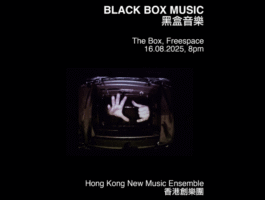
The review of Hong Kong New Music Ensemble's season opening concert on August 16th 2025 in Freespace, Kowloon West is out! You can read it below.
© 2025 HKNME
Opening their new 2025/2026 Season with the initiative GAME/PLAY, the Hong Kong New Music Ensemble (HKNME) seems determined to highlight the fun side of so-called new music. As their recently appointed Director of Programming Daniel Lo explained in his opening remarks, contemporary music is still too often perceived as overly serious, too heavy for an “average” listener. And who better to invite for such an occasion than the European contemporary music star Simon Steen-Andersen: a composer known for his transdisciplinary flair, his mischievous collisions of performance and theatre, and his uncanny ability to surprise through the joyous intersections of sound and vision. Whether in RunTime Error, where he gleefully uses a joystick to play two juxtaposed videos of himself running around a theatre, knocking objects over back and forth, or in his Piano Concerto, where a live pianist is set against a recording of a piano being dropped from a ceiling and smashed to pieces, Steen-Andersen’s work embodies humour and playfulness. A perfect match, then, for GAME/PLAY.
It was a true delight to enter Freespace, Hong Kong’s largest black box theatre (and arguably among the largest in Asia), its central seating area filled to the last chair: a sold-out show. This in itself was an outstanding achievement for a contemporary music concert, especially in August, when anyone who can usually escapes the endless storms and humidity of the Hong Kong summer. The stage set-up mirrored the program’s ambitions, a unique ambisonic disposition with roughly five musicians on each of the left and right walls, another five in the back, and a massive projection screen at the front facing the audience.
The concert began with the premiere of Antiphon, a work for 14 instruments by Daniel Lo, with live-processed visuals by his artistic partner, Yu Wing-yan, an experimental videographer who blends various visual genres and with whom he had already collaborated back in 2017. In keeping with the new season’s theme, and clearly resonating with the work of his esteemed guest Simon Steen-Andersen, the curator presented his own new piece that explored, as the program note put it, “the relationship between the music produced and the musicians’ performing gestures, as well as the connection between the audience’s sonic and visual experiences.” That description, if somewhat schematic, was in fact a fair summary of what unfolded.
The piece opened softly: two high strings in pizzicato, moving in contrary motion from unison to octave and back again, as if delineating the passage of time, almost like a rusty clock that intermittently ticks and stalls. Their fragile dialogue was punctuated by a sudden flurry of repeated notes played by individual brass instruments, which seemed to mask the subtle entry of new instrumental pairs, each joining the pulsing texture at the end of a crescendoing gesture. Suddenly a tutti swell broke through, landing on a downbeat, only to dissolve just as quickly. The process then restarted, like a slow unveiling, always with a subtle variation. Lo guided us almost didactically, gradually bringing each instrument into focus, and linking it to a simple geometric figure in Yu’s video: each shape distinct in colour, fixed in position, its pulsing intensity mirroring the rhythmical gesture of its musical counterpart. The first was a circle for the trumpet, later came triangles, ellipses, rhomboids, scattered across the screen like glowing glyphs.
I found it fascinating how the “movement” of these icons (which was not actual movement but a play of hue and brightness) corresponded to instrumental tuplets, triplets, quintuplets, sextuplets. Only later, in discussion with the artists, did I learn that each icon was generated from the live microphone signal, its intensity linked to the sound’s volume. As the piece progressed into its second third (around its golden mean), longer sustained notes appeared, still in short contrary sequences, and the density of instrumental pairs increased. These groupings of two, four, or six created a thicker sonic presence, mirrored visually as shapes began to overlap, cluster, and intermingle, forming an image faintly reminiscent of a schematic map of a city. Despite frequent hints of an impending climax—gestures swelling toward a common downbeat—the tension was never fulfilled. There was only one true tutti, quickly dissipating, and towards the end the music returned to its opening logic: counterpoint in pairs, punctuated by percussive gusts, only now softened into string harmonics and airy brass sounds. The piece closed with the same clipped interruptions that had defined it throughout. The players of HKNME proved themselves masters of performance in such a barren landscape, which could easily have fallen flat were it not for their expertise in generating nuance within the limited space of overwhelmingly soft and fragile sonorities.
What struck me most was the blend of simplicity and complexity, novelty and tradition. Complexity arose from the layering of many simple strands, simplicity, rooted in tradition, was found in the visual idiom itself: rudimentary shapes and bold colours that evoked early 20th-century Italian Futurism, especially when the screen became overfilled and plastered with icons. At the same time, this vocabulary resonated with contemporary culture, reflecting our everyday language of emojis, avatars, virtual masks and filters. It reinforced the idea that novelty is always relative, what feels new depends on what we have previously encountered.
Yet my subconscious evocation of early 20th-century aesthetics was no coincidence, sparked not only by Yu’s images. Lo’s filigree textures, more concerned with voids, chamber-like dialogues, and intervallic relationships than with full tutti or extended techniques (pizzicato and half-air sounds hardly counting as such), echoed Anton Webern, a contemporary of Futurist painters like Giacomo Balla and Ivo Pannaggi. Just as Webern was meticulous in his structures, so Lo never strayed from his concept of “anti-phon,” guiding us through his lacework of instrumental pairings in anti-parallel motion, always disrupted by short percussive gusts. This logic was doubled in Yu’s video, where icons too began to misbehave in agglomerations, disrupting the clean geometry of the system.
Now, it is rarely a good idea to compare one artwork with another. Yet given that the program note explicitly framed Antiphon as a kind of homage to Black Box Music, the temptation was too strong. Knowing some of Lo’s previous output, it was slightly surprising that he chose to work so directly with an audiovisual dynamic, terrain that is more Steen-Andersen’s strong suit. That is not to say Lo has never embraced multiple disciplines. His chamber operas A Woman Such as Myself and Women Like Us reveal his mastery in combining music and literature. But even in these projects, Lo remains, for the most part, a composer first, collaborating with others on theatrical and visual elements. By contrast, Steen-Andersen famously insists on doing everything himself, patches, videos, designs, electronics, as well as the music, of course. Lo’s foray into audiovisuality may thus feel a little out of character, a kind of experiment, perhaps even an act of homage. Yet I commend the effort. Often it is precisely by imitating our idols that we discover new paths, daring to venture into the unknown. Mastery comes through repetition and experimentation, until ideas ripen into maturity. And indeed, there is a certain vulnerability in Lo’s aesthetics that shines through here, a willingness to leave only the thinnest threads of sound, weaving them into a spider-like web of music. This demands a different kind of boldness, one that contrasts sharply with Steen-Andersen’s almost overconfident theatricality, and reveals Lo’s nuanced sensibility, which always places music itself at the centre.
While the outline of the two pieces was strikingly similar (instruments surrounding the audience, video projection at the front), what followed in Steen-Andersen’s Black Box Music (BBM) was, by its dramaturgy and flow, an entirely different beast. First premiered in 2012 at Darmstadt, BBM is one of the works that propelled the (then still young) Danish composer into international prominence. The fact that last week’s performance was already the 75th speaks volumes about the allure of Andersen’s mischievous style within the new music community, especially given how the notoriously fast-paced art world tends to crave endless novelty, only to discard its “babies” after one or two outings.
While the piece has a distinct multimedia character, as Andersen himself noted in the post-concert talk, there is no actual “high technology” involved, neither from the perspective of 2012, nor even less so today. What makes it remarkable is the simple but clever conceit: zooming in on the conductor’s hands and isolating them inside a box, much like an experimental vitrine for chemicals, projected onto a massive screen. It is a strikingly fresh angle, especially in the early 2010s, when the demand for artistic austerity often left little room for the kind of playfulness that BBM openly revels in.
Scored for 15 instruments (arranged here in three blocks of five players around the space) and a percussion soloist in front of the audience, his hands hidden inside the amplified “black box,” the piece demonstrated the virtuosic coordination of the HKNME and their guest percussionist Rodrigo Maqueda. Originally from Spain and now based in Basel, Maqueda describes himself as a heterodox artist moving between experimental art, electronic music, and club culture, with numerous solo projects that integrate percussion virtuosity, electronics, and light into immersive experiences. This heterogeneity of talents served him well in BBM, where he fused visual gesture and sonic signal with Swiss-clock precision, navigating constantly alternating groupings of 2, 3, and 4, along with sudden tempo shifts, which the HKNME piously followed (albeit with the help of a click track).
The piece begins dramatically: Maqueda’s hands part the curtains, unleashing a grand conducting gesture that triggers a loud, sustained tutti chord, only to snap shut again. This opening alternation of action and denial makes it clear that we are entering a theatre of the absurd, grandiose gestures collapsing into irony. From there, the piece slips into persiflage, venturing into “Mickey-mousing” territory, where hand signs trigger cartoon-like sonic effects. A “talking hand” gesture elicits wah-wah brass, a finger pistol sets off a whip crack, a phone-hanging signal coincides with a clipped piano pling. It is a Tom & Jerry world, delightfully ironic, especially in contrast to the gravity of Andersen’s older contemporaries like Marco Stroppa, Wolfgang Rihm, or Mathias Spahlinger.
It also marked a generational turn. Around that same Darmstadt edition, the focus on Cage was juxtaposed with younger voices like Jennifer Walshe, Stefan Prins, and Johannes Kreidler, composers who, like Andersen, cared less for pure sonic craft and more for the interplay of sound with visual elements, perception, and presentation format. BBM fit perfectly into that ethos. And yet, here lies my greatest critique. While the performance was faultless (Maqueda’s gestures crisp, the ensemble tight and passionate), I left with a nagging sense of absence. My memory of discovering this piece years ago was that of a revelation. As a student in Stuttgart, it struck me as a breath of fresh air against the heaviness of both my peers and the “established” masters. Later, during my doctorate at Stanford, I even included it as one of my self-chosen works for the qualifying exam. It was, for me, proof that farse and play could coexist with artistic rigour.
Hearing it live at last, 13 years later, was a different experience. Perhaps the vastness of Kowloon West’s Freespace, which demanded stronger amplification, dulled its impact. Was it the idealised memory of high-quality recordings contrasted with the natural imperfections of live performance? Or perhaps my momentary state of mind, my ears more experienced, and my expectations more demanding? The first ten minutes still charmed me with their humour, but after that, the surface quip seemed unable to deepen.
The middle section, with its resonating pitchforks, strings sustaining microtonal oscillations, and the plucking of rubber bands (later struck by a motorized ventilator), felt ingenious but, for me, slightly forced. The subsequent actions (balloons, cups, party streamers, electric fans) were always timed with Andersen’s masterly sense of dramaturgy, each arriving just before the previous idea wore thin, yet the whole remained locked in a “what you see is what you get” logic. For all its wittiness, the sonic vocabulary never truly expanded.
By the last 15 minutes I felt disconnected. Not bored—Andersen’s pacing is too precise for that—but unsatisfied, as if the piece’s greatest strength (its tight audio-visual amalgamation) had become its limitation. The cleverness of its sonic cues, so striking at first, began to fade into predictability, much like the sound of collecting coins in Super Mario, thrilling at first, only to quickly disappear into the background of habit. Given the large ensemble and extended techniques, one longs for some imaginative deviation, some unexpected drift towards a new sonic alloy, but it never arrives. This is not to deny Andersen’s achievement. The dramaturgy is flawless, honed over dozens of revisions (until, as he said, his publisher begged him to stop revising). The work remains powerful and enjoyable, even if, in 2025, it starts to feel slightly dated. While its perky nature anticipates TikTok-like short-attention gimmickry (which did not yet exist at the time it was written), its 45-minute span betrays the very new generation it seems to prefigure, clinging instead to the older generation’s belief that a piece must carry weight, even if through its length alone. The mismatch between its lightness of material and heaviness of form perhaps explains my ambivalence.
Still, in a field crowded with works lacking joy, craft, or sonic clarity (and God knows I paid my dues listening to hours of such concerts), Black Box Music remains a masterstroke. It proves that great art need not rely on “great material,” but on insightful concept and knife-sharp execution. It shows how a whole world can be built out of play, how childhood imagination, free of fear, rules, and correctness, can create something both simple and profound. I will always remember this piece as one that blew my mind when I was very young, and one that convinced me that contemporary music was still alive, worth pursuing, worth digging into. Even if my experience of it today was more tempered, I remain grateful to Maestro Andersen.
Summing up HKNME’s new season opener under the theme of GAME/PLAY, we see a particular interest in new forms - right from the ensemble layout, compact formats - a short, tightly curated concert under an hour, a focus on multimedia, and the curation of works which, judging by the sold-out tickets, enthusiastic applause, and engaged post-concert discussion, resonated strongly with a predominantly young audience. Connected conceptually yet strikingly different in execution, Antiphon and Black Box Music offered, on the one hand, vulnerability and delicate exploration, and on the other, spectacle and theatrical wit. Together, they displayed a spectrum of contemporary music that combines savoir-faire with carefree experimentation, reaching both seasoned connoisseurs and curious newcomers. The promise of more exciting concerts to come is clear, and we can eagerly await the rest of the season.
!SHAKE! is out - a physical model of a shaker. Go and test it out! Instead of browsing for hours looking for various shaker recordings online, you can now make shaker of any timbre & speed that you might need for your piece. Download HERE!
About !SHAKE!
!SHAKE! is a physical model of a hypothetical shaker. It begins with a white-noise signal, which is shaped by a bandpass filter centered around a user-defined frequency with subtle variations. The patch generates eight independent voices of this filtered noise, each with a slightly different center frequency and delay, thereby simulating the sound of multiple grains inside a shaker such as a maraca, caxixi, or egg shaker. The duration of one cycle is set in milliseconds. Each cycle consists of two shakes: the first reaches maximum intensity, while the second is slightly softer, imitating the natural motion of a shaker with an initial action followed by a rebound as the hand moves back and forth. Within this continuous flow, the noise~ object is interrupted by the train~ object, whose constant oscillation models the chaotic behavior of many grains moving at once. A BANG button allows the process to reset to a new set of random values. Additional realism is introduced through two cycle~ oscillators, which modulate dynamics between 0 dB and –15 dB. This recreates the small, natural fluctuations in loudness typical of a human performer. In short, rather than searching for recordings of different shakers, !SHAKE! allows you to generate a convincing digital imitation, controllable in frequency, speed, and dynamic variation, offering a flexible and natural-sounding alternative.
Contemporary Music Composer & Curator
Maison ONA info@db-vincze.com
Site by Daniel
Composer, Researcher, Conductor of Contemporary Music